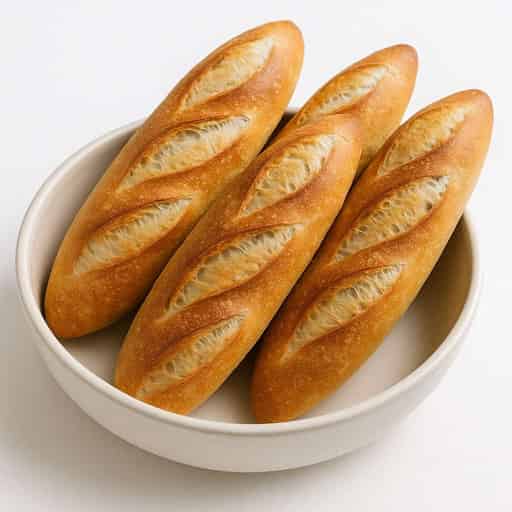
Bake four crisp-crusted homemade baguettes with a simple sponge dough. Clear shaping, steam, and cooling cues give this approachable bread a chewy crumb for sandwiches, soup, and cheese boards.
Prep time
25 min
Cook time
30 min
Total time
3 hr 30 min
Servings
16
Recipe Snapshot
DifficultyMedium
MealBreakfast / Lunch / Dinner
Freezer FriendlyYes
Family FriendlyYes
Chef's Tips
This recipe makes four baguettes, each intended for four portions. Use cool water in a warm kitchen so the sponge does not ferment too quickly.
Mix only until the dough is smooth and elastic; let the sponge and resting time develop gluten for you.
Proof just until slightly jiggly and airy—over-proofed baguettes will bake flat and pale.
Add boiling water to a preheated metal pan at the start of baking for steam; do not spray water onto oven glass, lights, or heating elements.
For extra flavour, cold-proof the shaped baguettes in the fridge for up to 12 hours and bake straight from chilled.
Tools Used
We use affiliate links, which may earn us a small commission at no extra cost to you.
Ingredients
Ingredients
Servings
16 servings1×
Scale
Ingredient amounts update instantly.
Sponge (First Dough)
Final Dough
Optional Herb Variation
For Steam
Instructions
Make the Sponge
- 1
In a medium bowl, whisk together the water and instant dry yeast until dissolved.
- 2
Add 250g strong bread flour and whisk until you have a smooth, thick batter with no dry pockets.
- 3
Cover the bowl and leave for 45–60 minutes, until the surface is bubbly and slightly domed. In a hot kitchen, use cooler water and check early.
Mix the Final Dough
- 1
Tip the bubbly sponge into the bowl of a stand mixer or a large mixing bowl.
- 2
Add the remaining 500g bread flour, salt, sugar and softened butter.
- 3
Mix on low speed until the dough starts to come together, then increase to medium and knead for 6–8 minutes, or knead by hand until smooth, elastic and slightly tacky but not sticky.
- 4
If using herbs, sprinkle them over the dough halfway through mixing so they are evenly distributed.
First Rise (Bulk Fermentation)
- 1
Shape the dough into a smooth ball and place it in a lightly oiled bowl.
- 2
Cover and leave to rise at room temperature for 45–60 minutes, or until slightly puffy and about 60–70% larger in volume.
- 3
If the dough feels tight, give it one or two gentle stretch-and-folds during the rise to strengthen the gluten.
Divide and Pre-shape
- 1
Turn the dough out onto a lightly floured work surface and gently flatten it into a rough rectangle, keeping as much gas as possible in the dough.
- 2
Use a dough scraper or knife to divide the dough into four equal pieces, about 300 g each, for standard home-oven baguettes.
- 3
Lightly shape each piece into a loose log, cover with a cloth and rest for 15–20 minutes to relax the gluten.
Shape the Baguettes
- 1
Working with one piece at a time, flatten it gently into a rough rectangle.
- 2
Fold the top edge down to the centre and seal with the heel of your hand, then fold again towards you and seal once more to build surface tension.
- 3
Roll the log from the centre outwards to your desired baguette length, tapering the ends slightly.
- 4
Place each baguette seam-side down on a perforated baguette tray or a parchment-lined baking sheet, leaving space between them.
Final Proof and Scoring
- 1
Cover the shaped baguettes lightly with a cloth or cling film and proof for about 30–40 minutes, or until noticeably lighter and slightly jiggly when the tray is shaken.
- 2
Towards the end of proofing, heat the oven to 220°C fan / 240°C conventional (430°F) with a baking sheet or stone inside. Put an empty metal roasting pan on the lowest rack for steam.
- 3
Just before baking, dust the baguettes generously with flour for a rustic look.
- 4
Using a sharp knife or bread lame, make 3–5 diagonal slashes along each baguette at a shallow angle, overlapping the cuts slightly. Score with quick, confident movements.
Bake with Steam
- 1
Place the baguettes, on their parchment, onto the preheated baking sheet or stone.
- 2
Carefully pour the boiling water into the preheated metal pan and close the door immediately. Keep hands and face clear of the burst of steam.
- 3
Bake for 25–30 minutes, until the baguettes are deep golden, crisp, and sound hollow when tapped underneath. If they colour too quickly, lower the oven by 10°C for the final 5 minutes.
- 4
Transfer to a wire rack and cool completely before slicing to allow the crumb to set.
Plan This Recipe
Save this recipe to one of your meal plans or browse your existing plans.
Learn More
Everything you want to know about this recipe.
Easy Sponge-Method Baguettes
Easy Sponge-Method Baguettes
These homemade baguettes are designed for the equipment most home bakers already have: a mixing bowl, a baking sheet, and a small metal pan for steam. The sponge gives the dough a head start on flavour and gluten development, so you can make four crisp-crusted loaves without a starter or a baking stone.
They are not intended to replace the longer fermentation in our classic French baguettes. Choose this recipe when you want a same-day loaf with a chewy crumb and a firm, crackly crust; choose the classic recipe when you have time for an overnight dough.
Why the Sponge and Steam Work
The sponge is a loose mixture of flour, water, and yeast left until bubbly. That rest starts gluten development before the final dough is mixed, making the dough smoother and easier to shape without excessive kneading. It also gives the finished bread more wheaty aroma than a straight dough mixed and baked immediately.
Steam delays the crust setting during the first part of the bake. The loaves can expand through the scores before the crust firms, then dry heat sets the deeply golden finish. A preheated metal pan and carefully added boiling water are enough; a dedicated steam oven is not required.
Shape, Score, and Bake With Confidence
Use only enough flour to keep the bench from sticking. Too much bench flour makes the seam difficult to seal and leaves dry streaks in the dough. During shaping, press firmly enough to create surface tension but avoid flattening all the gas from the first rise.
Score just before baking with a sharp blade held at a shallow angle. The cuts should overlap along the length of each loaf. If the dough drags or collapses, it may be over-proofed; bake it as it is rather than trying to deepen the cuts.
Common Baguette Problems
Why did the baguettes spread instead of rising? The dough may have proofed too long or lacked surface tension. Stop the final proof when the loaves are lighter and gently jiggly, not doubled and fragile, then shape each piece with a firm sealed seam.
Why is the crust pale or soft? Fully preheat the oven and baking surface, use the steam pan at the beginning, and bake until deeply golden. A baguette will soften as it cools if it is covered; leave it uncovered on a wire rack.
Why is the crumb gummy? It is usually underbaked or sliced while still hot. Let the loaves cool completely so moisture redistributes and the crumb sets.
Serving and Storing
Serve the baguettes the day they are baked with soup, a simple cheese board, or as the base for roast beef baguette sandwiches. For a softer, herb-scented bread, try the optional rosemary variation; fold the herbs into the final dough rather than the sponge.
Freeze fully cooled loaves in a tightly sealed bag for up to one month. Reheat from frozen at 180°C fan / 200°C conventional for 10–12 minutes, directly on the oven rack, until hot and crisp again.
Nutrition Facts
Nutrition Facts
Serving Size: 1 slice baguette (about 50g)
Calories 1809%
% Reference Intake*
Total Fat 2g3%
Saturated Fat 1g5%
Trans Fat 0g
Cholesterol 5mg
Sodium 290mg
Total Carbohydrates 37g14%
Dietary Fiber 2g
Sugars 1g1%
Protein 5g10%
* Reference intakes are based on an average adult's 8,400 kJ / 2,000 kcal diet. Your needs may be higher or lower.
FAQs
Does this dough need to pass a full windowpane test?
No. Because the recipe uses a sponge, the gluten is already partly developed. Aim for a soft, elastic dough that stretches thin with some translucency, but it doesn’t need a perfect, ultra-thin windowpane like brioche.
Can I cold-proof the shaped baguettes overnight?
Yes. After shaping, place the baguettes on a tray, cover well and chill for up to 12 hours. Bake straight from the fridge, adding a couple of extra minutes to the baking time. You’ll get even better flavour and colour.
Can I freeze this bread?
Once fully cooled, wrap the baguettes tightly and freeze for up to one month. Reheat from frozen in a 180°C oven for 10–12 minutes until the crust is crisp again.
Community Reviews
See how other home cooks made this recipe, then share your own experience.
4.7
6 ratings
5
67%
4
33%
3
0%
2
0%
1
0%
How would you rate this recipe?
Share your experience and help others.
Ian W.
· 30 Aug 2026The shaping notes helped me avoid pressing all the air out. Mine were not perfectly even, but the crust was crisp and the crumb stayed pleasantly chewy.
Rachel P.
· 21 May 2026I made four smaller loaves and froze two once cool. They refreshed well in the oven and were especially good alongside soup.
Noa B.
· 14 Feb 2026The sponge was straightforward and the boiling-water pan gave me the crisp crust I had been missing with my usual baking-sheet bread.
Anne
· 15 Jan 2026First time making baguette and it actually worked. My shaping still needs practice but the crumb was soft and chewy.
Miguel
· 15 Dec 2025Did an overnight fridge proof and the flavour was amazing. Definitely cheaper and better than store-bought baguette.
Lara
· 15 Nov 2025Loved how simple this sponge method was. Crust turned out super crispy even in my small oven!
Create Your Own Recipe
Add your personal creations and build your own recipe collection.