24 September 2026
Brioche Pain Suisse with Vanilla Custard and Chocolate
RecipeShare Test Kitchen
5.0(4 ratings)
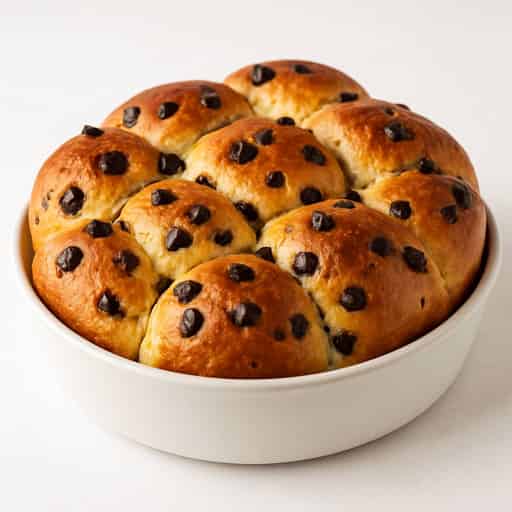
A simplified brioche pain suisse filled with thick vanilla custard and dark chocolate. It has the familiar chocolate-custard flavour without laminated croissant dough.
Prep time
45 min
Cook time
22 min
Total time
3 hr 7 min
Servings
10
Time Plan
1 hr 15 min active · 3 hr 7 min total
- First rise1 hr 15 min
- Chill the custard45 min
- Final proof50 min
Recipe Snapshot
DifficultyMedium
MealBreakfast / Snack
Freezer FriendlyYes
Family FriendlyYes
CuisineFrench
Chef's Tips
Make the custard cold and thick before filling; it should spread, not pour.
Keep the dough lightly floured and use a bench scraper to lift it rather than working in extra flour.
Bake until the tops are deeply golden and the centers feel springy; pale buns can remain doughy around the custard.
Tools Used
Stand Mixer With Dough Hook(opens in a new tab)Mixing Bowl(opens in a new tab)Saucepan(opens in a new tab)Whisk(opens in a new tab)Rolling PinBaking Tray(opens in a new tab)Pastry Brush
We use affiliate links, which may earn us a small commission at no extra cost to you.
Ingredients
Ingredients
Servings
10 servings1×
Scale
Ingredient amounts update instantly.
Brioche Dough
Approx. 983 gVanilla Custard
Approx. 825 gFill And Finish
Instructions
Mix and Proof the Brioche Dough
- 1
Add the flour and sugar to the bowl of a stand mixer. Crumble in the fresh yeast, then add the lukewarm milk, egg, and vanilla. Mix with the dough hook on low until no dry flour remains, about 2 minutes.
- 2
Add the salt and mix for 3 minutes. Add the softened butter a piece at a time, letting each piece mostly disappear before adding the next.
- 3
Knead on medium-low for 6 to 8 minutes, until the dough is smooth, elastic, and tacky rather than wet. Cover and leave to rise until puffy and close to doubled, 1 to 1 1/2 hours.
Make and Chill the Vanilla Custard
- 1
Heat the milk, half the sugar, and vanilla in a saucepan until steaming around the edges. Meanwhile, whisk the eggs, remaining sugar, and cornstarch in a heatproof bowl until completely smooth.
- 2
Whisk the hot milk gradually into the egg mixture, then return it all to the saucepan. Cook over medium heat, whisking constantly, until it is very thick and bubbles slowly; continue whisking for 1 minute.
- 3
Remove from the heat and whisk in the butter. Spread the custard in a shallow dish, press baking paper directly onto its surface, and chill until cold and firm enough to spread, at least 45 minutes.
Fill and Shape the Buns
- 1
Line a baking tray with parchment. On a lightly floured surface, roll the risen dough into a 40 x 50 cm (16 x 20 inch) rectangle. Lift and reposition the dough with a bench scraper if it begins to stick.
- 2
Spread the cold custard over one short half of the rectangle, leaving a 2 cm (3/4 inch) border. Scatter the chocolate chips over the custard, then fold the unfilled half over it and press the edges gently to seal.
- 3
Trim only if needed, then cut across the folded dough into 10 equal rectangles. Space them well apart on the lined tray, cover loosely, and proof until noticeably puffy, 45 to 60 minutes.
Bake and Serve
- 1
Heat the oven to 160C fan / 180C conventional (350F). Beat the egg with the milk and brush a thin, even layer over the proofed buns.
- 2
Bake for 20 to 22 minutes, rotating the tray once if needed, until deeply golden and springy at the edges. Cool for 15 minutes before serving so the hot custard can settle.
Plan This Recipe
Save this recipe to one of your meal plans or browse your existing plans.
Learn More
Everything you want to know about this recipe.
A Simplified Brioche Pain Suisse
A Simplified Brioche Pain Suisse
Pain suisse is a French breakfast pastry with vanilla pastry cream and chocolate. In many French bakeries it is made with laminated yeast dough, which produces flaky layers; some bakeries also call that pastry brioche suisse. This recipe deliberately takes a different route: soft enriched brioche is folded around cold custard and chocolate, so it gives the same familiar filling in a tender bun without a butter block or repeated lamination.
That difference is worth stating plainly. These buns are plush and bread-like, not crisp and flaky like a croissant. The simplified method is the reason this page previously used “lazy baker’s” in its name: it removes lamination rather than claiming to reproduce the traditional pastry exactly. PAUL likewise describes its Suisse/Brioche Suisse as a laminated-yeast-dough pastry with pastry cream and chocolate chips.
Why This Brioche Version Works
Why This Brioche Version Works
The dough is enriched with milk, egg, and butter, which keeps the crumb soft enough to contrast with the chilled custard. Bread flour matters here: it gives the dough the strength to be rolled, folded, proofed, and baked around a moist filling without tearing.
The custard is intentionally thicker than one you would serve in a bowl. Cornstarch sets it into a cold, spreadable layer, while the butter keeps it smooth after baking. Cold custard and a clean border are the two most useful protections against leaks. Dark chocolate supplies a slight bitterness that balances a custard-rich bun and stays in distinct pockets rather than melting completely into the filling.
For a more deeply enriched dough to use in other shapes, see our Bakery-Style Brioche Dough.
Technique Notes
Technique Notes
Develop the dough before judging it. It will look soft at first. Continue kneading until it stretches without immediately tearing and feels tacky rather than soupy; working in lots of flour is the usual cause of a dry finished bun.
Use custard cold from the refrigerator. If it is warm or loose, it will slide when the dough is folded and can seep onto the tray. The finished custard should be firm enough to hold a line from a spoon.
Proof for volume, not just the clock. The shaped buns should look rounded and airy before they go into the oven. If they spring straight back when lightly touched, give them more time; if they look deflated or fragile, they have likely gone too far.
Common Problems
Common Problems
The buns are dense. The dough may not have been kneaded long enough, or it may have gone into the oven before the final proof. Use the puffy appearance and gentle spring of the dough as the guide, especially in a cool kitchen.
The filling leaked out. Make sure the custard was cold and thick, leave the border clear, and avoid overfilling the fold. A little chocolate escaping is normal; a pool of custard usually means it was still warm or too loose.
The centers seem underbaked. Custard-filled buns need a well-coloured top. Bake until deep golden, then let them stand for 15 minutes so the filling and crumb finish setting from residual heat.
Make Ahead and Serving
Make Ahead and Serving
The custard is ideal to make the day before. For fresh-baked breakfast buns, shape them the evening before, refrigerate the tray loosely covered, then let them lose their chill and become puffy before baking. Serve warm with coffee or tea; one bun is a rich pastry serving, and the nutrition figures are estimates per bun and will vary with the chocolate used.
The baked buns are best on the day they are made. Rewarm day-old buns briefly in a low oven, or freeze fully cooled buns and reheat after thawing. Do not refrigerate baked buns unless necessary, as the brioche firms up more quickly there.
Nutrition Facts
Nutrition Facts
Serving Size: 1 bun
Calories 49025%
% Reference Intake*
Total Fat 20g29%
Saturated Fat 12g60%
Trans Fat 0g
Cholesterol 105mg
Sodium 210mg
Total Carbohydrates 68g26%
Dietary Fiber 3g
Sugars 31g34%
Protein 10g20%
* Reference intakes are based on an average adult's 8,400 kJ / 2,000 kcal diet. Your needs may be higher or lower.
FAQs
Is this a traditional laminated pain suisse?
No. Traditional pain suisse, also called brioche suisse by some bakeries, is usually made with laminated yeast dough. This is a simplified folded brioche version with the same vanilla-custard and chocolate combination.
Can I make these with instant yeast?
Yes. Use 5 g (about 1 1/2 teaspoons) instant yeast and mix it directly with the flour. Keep the milk lukewarm rather than hot.
Why is my brioche dough sticky?
This is a soft, enriched dough. Knead until it is elastic, then use only enough flour to stop it sticking to the bench; adding much more makes the buns dry and dense.
Can I prepare the buns ahead?
Make the custard up to one day ahead and refrigerate it with its surface covered. You can also shape the buns, refrigerate them overnight, then let them sit at room temperature for 30 to 45 minutes before baking.
How should I store and reheat pain suisse?
Keep cooled buns airtight at room temperature for one day. Freeze them once fully cool for up to one month, then thaw and warm in a 160C oven until soft and heated through.
Community Reviews
See how other home cooks made this recipe, then share your own experience.
5.0
4 ratings
5
100%
4
0%
3
0%
2
0%
1
0%
How would you rate this recipe?
Share your experience and help others.
Hannah R.
· 2 Sept 2026The dough was soft and the dark chocolate kept the filling from tasting overly sweet. Reheated one the next day and it was still excellent.
Theo M.
· 7 Jul 2026A good weekend alternative when I wanted the custard-and-chocolate idea without making laminated dough.
Nadia L.
· 18 May 2026Chilling the custard properly made shaping much easier. Mine were soft and nicely filled without any leaking.
Brie T.
· 9 Mar 2026The custard stayed creamy and the buns baked up beautifully golden. Very doable for a weekend project.
Amanda Saenz
· 23 Mar 2025No this looks awesome and I will be making this.
Marius
· 22 Mar 2025Looks good but looks nothing like a real pain suisse in France.
Fernando
· 22 Mar 2025No laminating. Love it.
Create Your Own Recipe
Add your personal creations and build your own recipe collection.