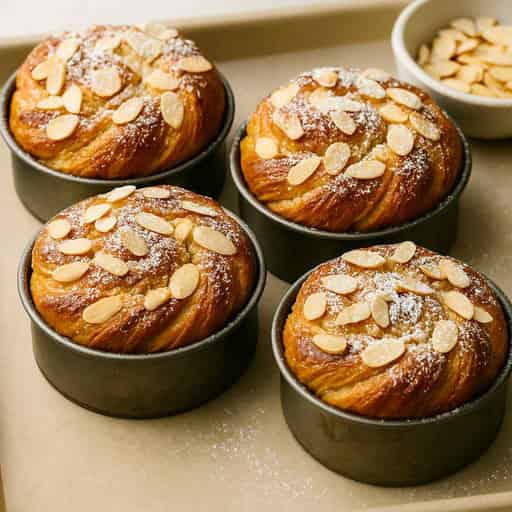
Flaky lattice apple croissant pastries with lemon apple compote and a crisp sugar top. A rewarding laminated-dough baking project for eight pastries.
Prep time
1 hr 10 min
Cook time
22 min
Total time
4 hr 45 min
Servings
8
Recipe Snapshot
DifficultyAdvanced
MealBreakfast / Dessert
Family FriendlyYes
CuisineFrench
Chef's Tips
Keep the dough and butter at the same cool, pliable texture so the butter does not break into the dough.
Chill the compote completely; warm filling melts the butter layers before proofing.
Proof until the pastries look puffy and wobble slightly when the tray is nudged, rather than following the clock alone.
Bake until the lattice is a deep golden brown; pale pastries will be doughy between the layers.
Tools Used
We use affiliate links, which may earn us a small commission at no extra cost to you.
Ingredients
Ingredients
Servings
8 servings1×
Scale
Ingredient amounts update instantly.
Croissant Dough
Lemon Apple Compote
Egg Wash And Finish
Instructions
Mix and Chill the Dough
- 1
Combine the flour, yeast, sugar, and salt in the bowl of a stand mixer. Add the cold water, egg, and honey. Mix on low until a shaggy dough forms, then knead on medium-low for 4 minutes.
- 2
Add the softened 25 g butter and knead just until smooth and elastic, about 2 minutes more. Press into a 15 cm square, wrap, and refrigerate for 1 hour.
- 3
Meanwhile, place the 120 g lamination butter between parchment sheets and roll it into an even 12 cm square. Refrigerate until firm but flexible.
Make and Cool the Apple Compote
- 1
Combine the apples, lemon juice, and sugar in a saucepan. Cook over medium heat for 8 to 10 minutes, stirring often, until the apples are soft and the juices are thick and jammy.
- 2
Transfer to a shallow bowl and cool completely. The compote must be cold and thick enough to sit on a spoon without running.
Laminate the Dough
- 1
Roll the chilled dough into a 20 cm square. Put the butter block in the centre at a diagonal, fold the dough corners over it, and pinch the seams closed.
- 2
Roll the package into a 20 by 45 cm rectangle. Fold the top third down and the bottom third up like a letter. Wrap and chill for 30 minutes.
- 3
Repeat the roll, letter fold, and 30-minute chill twice more, turning the dough 90 degrees before each roll. After the final fold, chill for at least 30 minutes.
Shape, Proof, and Bake
- 1
Roll the dough on a lightly floured surface to 3.5 mm thick. Cut eight 12 cm circles for the bases and eight 10 cm circles for the tops. Cut a small lattice of parallel slits in each top circle.
- 2
Spoon about 45 g cold compote onto each base, leaving a 1.5 cm border. Lay on a lattice top, press the edges firmly to seal, and arrange the pastries on lined trays.
- 3
Cover loosely and proof at warm room temperature for 1 1/2 to 2 hours, until visibly puffy and gently jiggly. Heat the oven to 190C (170C fan / 375F).
- 4
Whisk the egg yolk and milk, then brush the pastries gently without flooding the cut edges. Sprinkle with caster sugar and bake for 20 to 22 minutes, until deeply golden and flaky.
- 5
Cool on the tray for 10 minutes, then transfer to a rack. Serve warm or at room temperature, when the compote has settled and the layers are crisp.
Plan This Recipe
Save this recipe to one of your meal plans or browse your existing plans.
Learn More
Everything you want to know about this recipe.
Lattice Apple Croissant Pastries with Lemon Apple Compote
Lattice Apple Croissant Pastries with Lemon Apple Compote
These lattice apple croissant pastries are a laminated-dough project for when a plain apple turnover is not quite enough. Each pastry has a tender, yeasted butter layer around a cool-set lemon apple compote, with a smaller latticed top that opens as the dough expands in the oven.
They are not a shortcut puff-pastry bake. The dough needs chilling, folding, and proofing, but those rests are what create the delicate, croissant-like interior. Most of the elapsed time is hands-off; the active steps are easiest when the dough stays cold and the compote is made during its first chill.
Why This Recipe Works
Why This Recipe Works
The dough is sized for eight pastries, so it is practical to roll and laminate at home. Strong bread flour gives the dough enough strength to hold the butter layers, while the small amount of butter mixed into the dough keeps the baked crumb tender. The 120 g butter block provides enough fat for defined layers without making the dough difficult to handle.
Three letter folds build thin, even layers. Chilling between every fold is not optional: it gives the gluten time to relax and keeps the butter in sheets rather than mixing it into the dough. The apple compote is cooked until jammy and cooled fully so it stays inside the pastry instead of soaking the layers.
The Important Texture Cues
The Important Texture Cues
The dough and butter should both bend without cracking. If the butter snaps, wait a few minutes before rolling; if it feels greasy or pushes through the dough, chill the packet before continuing. Use only enough flour to stop sticking, brushing away excess before folding so the layers do not become dry.
Proofed pastries should look inflated and wobble gently when the tray moves. Under-proofed pastries force butter out in the oven; over-proofed ones lose definition. Bake until deeply golden, not merely blond, so the centre layers are cooked through and the sugar top is crisp.
Serving and Storage
Serving and Storage
Serve the pastries warm or at room temperature with coffee, tea, or a spoonful of lightly whipped cream. They are best on the day they are baked. Store any cooled leftovers airtight at room temperature for up to one day, then refresh in a 160C oven for 5 to 7 minutes.
The laminated dough can rest overnight after its final fold, making these a good brunch project. For a different apple pastry format, see apple turnovers with croissant dough, which wrap an apple filling rather than using a latticed top. For a caramelised apple dessert with a different technique, try classic apple tarte Tatin.
Common Problems
Common Problems
Why is my dough shrinking while I cut the circles?
It is too warm or has not rested long enough after rolling. Cover it and chill for 10 to 15 minutes, then cut the circles without stretching them.
Why is the pastry pale or doughy in the centre?
The oven may be running cool, the pastries may be too thick, or they may have been removed before the lattice was deeply golden. Return them to the oven for a few minutes if the base is still pale.
Why did the apple filling leak?
Use cold, thick compote and leave the 1.5 cm border clear. Press the edges firmly, but do not smear compote onto the seal, which prevents the dough from sticking.
Nutrition Facts
Nutrition Facts
Serving Size: 1 pastry
Calories 37019%
% Reference Intake*
Total Fat 19g27%
Saturated Fat 12g60%
Trans Fat 0g
Cholesterol 70mg
Sodium 310mg
Total Carbohydrates 48g18%
Dietary Fiber 2g
Sugars 16g18%
Protein 8g16%
* Reference intakes are based on an average adult's 8,400 kJ / 2,000 kcal diet. Your needs may be higher or lower.
FAQs
Can I use all-purpose flour instead of strong bread flour?
Yes, provided it is plain flour rather than cake flour. The dough may be slightly less elastic, so roll gently and chill whenever it resists.
Can I make the dough ahead?
Yes. After the third fold, wrap the dough and refrigerate overnight. Let it sit for 10 minutes at room temperature before rolling if it is too firm.
Can I use store-bought puff pastry?
Yes, for a faster alternative. It will make a crisp apple pastry but not the tender, yeasted layers of croissant dough. Use a 500 to 600 g all-butter sheet and bake without proofing.
Why did butter leak from my pastries?
The butter may have softened too much, the dough may have torn during rolling, or the pastries may have been under-proofed. Keep the dough cool, repair tears promptly, and proof until puffy.
Community Reviews
See how other home cooks made this recipe, then share your own experience.
4.8
5 ratings
5
80%
4
20%
3
0%
2
0%
1
0%
How would you rate this recipe?
Share your experience and help others.
Ben
· 23 Sept 2026The smaller latticed top makes these look polished without being difficult to shape. Worth the laminated-dough project.
Harriet
· 13 Sept 2026The proofing cue was more useful than a fixed time. Mine baked with crisp layers and a soft apple centre.
Lia
· 7 Sept 2025Prepped the dough the night before—turned out great!
Marco
· 18 May 2025The lemony apple compote keeps everything bright. Amazing flakes.
Anna
· 2 Apr 2025Made these for brunch—everyone thought they were from a bakery!
Create Your Own Recipe
Add your personal creations and build your own recipe collection.