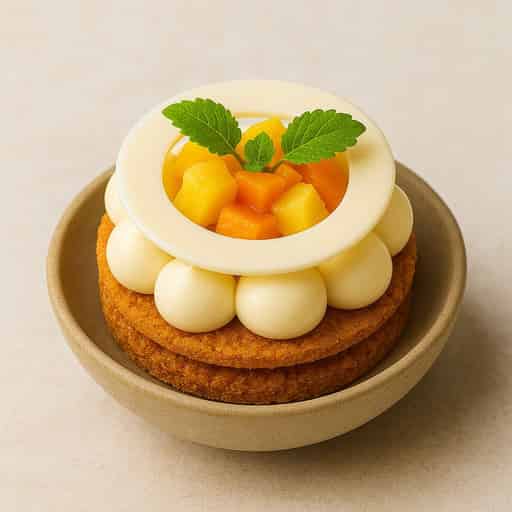
A home-baker coconut daisy entremet with whipped coconut ganache, lemon gel, almond-coconut dacquoise and a thin white-chocolate coconut crunch layer.
Prep time
2 hr 30 min
Cook time
20 min
Total time
24 hr
Servings
12
Time Plan
2 hr 50 min active · 24 hr total
- Chill the coconut ganache12 hr
- Freeze the assembled entremet6 hr
- Thaw in the refrigerator4 hr
Recipe Snapshot
DifficultyAdvanced
MealDessert
Freezer FriendlyYes
Chef's Tips
Use a scale for the gelatin, agar and xanthan gum. Small differences change the texture of the gels and whipped ganache.
Chill the coconut ganache for at least 12 hours before whipping; it should be cold throughout but not frozen.
Freeze the dacquoise insert and completed entremet solid before unmoulding so the layers remain neat.
This quantity makes a 23-cm moulded entremet about 4 cm high before the daisy decoration. Use a mould at least 5 cm deep for headroom.
The lemon gel must be blended after it sets. This turns a firm agar jelly into a smooth gel that can be piped or spooned.
Keep the coconut crunch disk no thicker than 2–3 mm. A thin, well-coated layer cuts cleanly after chilling and stays crisper than a thick compact one.
Tools Used
Stand Mixer Or Hand Mixer(opens in a new tab)Mixing Bowls(opens in a new tab)Saucepan(opens in a new tab)Fine-mesh Sieve(opens in a new tab)Rubber Spatula(opens in a new tab)Parchment Paper(opens in a new tab)FreezerOven
We use affiliate links, which may earn us a small commission at no extra cost to you.
Tin & Mould
23-cm round entremet mould or springform pan
23 cm diameter · 5 cm deep
Ingredients
Ingredients
Servings
12 servings1×
Scale
Ingredient amounts update instantly.
Coconut Whipped Ganache
Almond-Coconut Dacquoise Insert
Approx. 271 gCoconut And Lemon Gels
Coconut Crunch Layer
Approx. 76 gDaisy Finish
Instructions
Make the Coconut Whipped Ganache (Day 1)
- 1
Stir the gelatin powder with 15 g cold water in a small bowl and leave it to bloom for 5 minutes. Put the cold mascarpone in a large jug or bowl.
- 2
Bring the cream and toasted coconut just to a simmer in a saucepan. Remove from the heat, cover and infuse for 10 minutes, then strain.
- 3
Whisk the egg yolks and sugar in a heatproof bowl. Gradually whisk in the warm coconut cream, then return everything to the saucepan.
- 4
Cook over low heat, stirring constantly, until the custard reaches 82–84°C and lightly coats a spatula; do not let it boil. Remove from the heat and stir in the bloomed gelatin.
- 5
Blend in the 500 g coconut milk, then pass the mixture through a fine-mesh sieve over the mascarpone. Blend until completely smooth. Cover and refrigerate for at least 12 hours.
Bake the Dacquoise and Make the Gels (Day 2)
- 1
Heat the oven to 170°C (150°C fan). Line the base of a 20-cm loose-bottomed cake tin with parchment.
- 2
Whip the egg whites to soft peaks. Add the 38 g sugar in three additions and whip to a glossy, firm meringue.
- 3
Sift together the ground almonds, coconut, flour and confectioners' sugar. Fold them into the meringue in two additions. Spread the batter evenly in the lined tin.
- 4
Bake for 16–18 minutes, until lightly golden and springy. Cool fully, then freeze the disk flat for 30 minutes.
- 5
For the coconut gel, blend 100 g coconut milk on high speed and slowly sprinkle in the xanthan gum. Blend for 1 minute until thick and smooth.
- 6
For the lemon gel, whisk the 15 g sugar and agar together. Bring the lemon juice to a boil, whisk in the sugar mixture and boil for 1 minute. Pour into a shallow container and refrigerate until firm.
- 7
Cut the set lemon gel into pieces and blend until glossy and smooth. Transfer it to a piping bag or small bowl.
Make the Coconut Crunch Layer
- 1
Melt the cocoa butter and white chocolate gently. Stir in the feuilletine, 15 g toasted coconut and salt, coating the flakes evenly. Spread it inside a parchment-lined 20-cm tin, pressing only lightly into an even disk no thicker than 2–3 mm. Refrigerate until firm.
Assemble and Freeze the Entremet
- 1
Spread the coconut gel over the frozen dacquoise. Pipe or spoon small dots of lemon gel over the surface, leaving a 1-cm border. Freeze until firm, at least 1 hour.
- 2
Line a 23-cm round entremet mould or springform pan, at least 5 cm deep, with acetate. The moulded cake will be about 4 cm high before decoration. Whip the cold coconut ganache to medium peaks; stop as soon as it holds a curved peak. Transfer about 100 g to a piping bag and refrigerate for the daisies.
- 3
Spread about one-third of the ganache over the base and up the sides of the lined pan. Set the chilled coconut crunch disk in the centre, then place the frozen dacquoise insert on top, lemon-gel side up. Cover with the remaining ganache and smooth the top.
- 4
Freeze until completely solid, at least 6 hours or overnight.
- 5
Unmould the frozen entremet and set it directly on a chilled serving plate or cake board.
Finish as Simple Daisies
- 1
Let the cake stand for 10 minutes, then use any remaining lemon gel to pipe a small centre and five to six short ganache petals around it. Make 6 to 8 daisies across the top; a large star tip makes this easiest.
- 2
Scatter the optional toasted coconut around the daisies. Refrigerate for 4 hours before slicing so the ganache thaws to a light, creamy texture. For the best crunch, let the cake stand at cool room temperature for 15–20 minutes before serving.
Plan This Recipe
Save this recipe to one of your meal plans or browse your existing plans.
Learn More
Everything you want to know about this recipe.
Coconut Daisy Entremet with Lemon Gel
Coconut Daisy Entremet with Lemon Gel
This home-baker coconut daisy entremet keeps the contrasts that make the original special: a light whipped coconut ganache, tender almond-coconut dacquoise and sharp lemon gel. It is still a make-ahead celebration cake, but it avoids a spray gun, cocoa-butter coatings, separate frozen flower petals and a separate tart base.
Why This Version Is More Manageable
Why This Version Is More Manageable
The 20-cm dacquoise becomes one frozen insert rather than several small moulded parts. Full-fat canned coconut milk makes the coconut element practical to shop for, while a thin white-chocolate coconut crunch replaces a separate caramel-and-praline project. A little cocoa butter coats the flakes more completely, slowing moisture transfer without making a thick hard slab. Set directly beneath the dacquoise, it gives the cake a crisp layer without requiring a tart base. A star tip turns the remaining ganache and lemon gel into recognisable daisies directly on the cake.
Timing That Keeps the Layers Calm
Timing That Keeps the Layers Calm
Make the ganache the day before: the long chill is essential for a smooth whip. The next day, bake the dacquoise, set and blend the lemon gel, then freeze the assembled cake overnight. On serving day, unmould it onto a chilled plate and allow four hours in the refrigerator. This thaw is what changes the firm frozen ganache into a light mousse-like filling.
Ingredient Notes and Substitutions
Ingredient Notes and Substitutions
Use full-fat, unsweetened canned coconut milk, shaken until no thick cream remains in the can; do not use sweetened cream of coconut. Use unsweetened desiccated coconut for every reference to shredded coconut. If feuilletine is difficult to find, lightly crush plain cornflakes; they will be less delicate but still give the crunch its needed texture. Use a 20-cm loose-bottomed tin for both the dacquoise and the crunch disk, and a 23-cm entremet mould or springform pan, at least 5 cm deep, for the finished cake. The moulded cake is about 4 cm tall; the piped daisies add roughly another 1 cm in places. Line the larger mould with acetate for the cleanest sides.
Daisy Piping Without Specialist Equipment
Daisy Piping Without Specialist Equipment
Pipe a lemon-gel dot first, then pipe five or six short ganache strokes around it. The daisies do not need to match perfectly—varying their sizes looks natural. If the ganache softens while you pipe, refrigerate the bag for 10 minutes, then continue.
Portion Guidance for Goals
Portion Guidance for Goals
Serve one narrow slice, about one-twelfth of the cake. It is rich in coconut, mascarpone and white chocolate, so it works best as a planned dessert rather than an everyday snack.
When to Eat
When to Eat
Serve after a celebratory meal, afternoon tea, or a dinner party. Let the cake thaw in the refrigerator rather than at room temperature so the ganache stays cleanly sliced.
Balance Tip
Balance Tip
Pair a slice with fresh berries or a fruit-forward main course earlier in the meal. The lemon gel provides acidity, but it does not make the dessert low in sugar or saturated fat.
Storage
Storage
Keep the finished cake covered in the refrigerator for up to two days. The cocoa-butter coating helps the coconut crunch remain crisper on day two, but it is still at its best on the first day. After the four-hour refrigerator thaw, let the cake stand for 15–20 minutes at cool room temperature before serving; this softens the thin chocolate layer without letting the ganache become loose. The frozen, undecorated entremet keeps well for up to two weeks when wrapped tightly; thaw it overnight in the refrigerator, then decorate.
Nutrition Facts
Nutrition Facts
Serving Size: 1 slice (1/12 cake)
Calories 44522%
% Reference Intake*
Total Fat 34g49%
Saturated Fat 24g120%
Trans Fat 0g
Cholesterol 120mg
Sodium 120mg
Total Carbohydrates 32g12%
Dietary Fiber 3g
Sugars 24g27%
Protein 7g14%
* Reference intakes are based on an average adult's 8,400 kJ / 2,000 kcal diet. Your needs may be higher or lower.
Community Reviews
See how other home cooks made this recipe, then share your own experience.
4.7
3 ratings
5
67%
4
33%
3
0%
2
0%
1
0%
How would you rate this recipe?
Share your experience and help others.
Aileen
· 2 Dec 2025I swapped half the mascarpone for cream cheese and loved the slight tang. Not for beginners, but useful for a planned celebration dessert.
Marco
· 30 Nov 2025Followed the recipe over two days and it worked great. My daisy piping was not as neat as the photo, but the textures inside worked well.
Lara
· 26 Nov 2025Made this for a birthday with strong coconut flavour, but the lemon stops it from being heavy. Definitely a weekend project but worth it.
Create Your Own Recipe
Add your personal creations and build your own recipe collection.