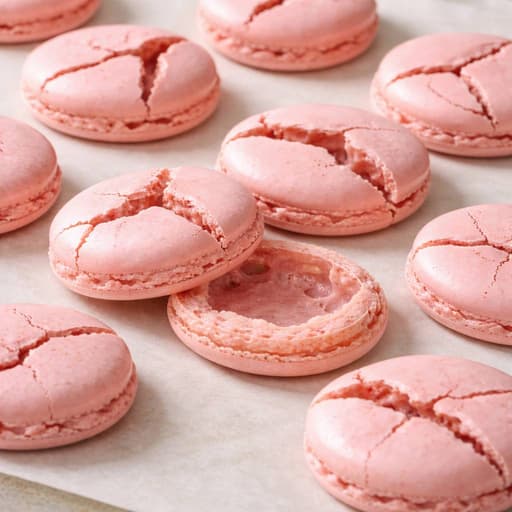
Why Macarons Crack and What It Usually Means
Cracked macarons usually point to a few repeat problems: unstable batter, poor drying, trapped steam, or harsh oven heat. Here is what those signals often mean.
Macarons crack in a way that feels dramatic, but the reason is usually not mysterious. A cracked shell is almost always a pressure problem: the top sets too early, the inside keeps pushing, and the shell breaks where it is weakest.
Dek: This guide looks at the most common reasons macarons crack, what those cracks usually signal, and why the problem often starts before the tray even goes into the oven.
The Crack Is Usually the Final Symptom, Not the First Mistake
When a macaron shell splits on top, the oven is just revealing a problem that was already built into the batter, the drying stage, or the heat pattern. The crack is visible, but the cause is often upstream: unstable meringue, undermixed or overmixed batter, shells that never formed a proper skin, or an oven that pushes steam upward too aggressively.
That is why two trays made from the same recipe can behave differently. Macarons are unusually sensitive to accumulated small errors. One weak stage rarely ruins them on its own, but several small misses tend to show up as cracks.
Weak Drying Leaves the Top Too Fragile
One of the most common causes is incomplete drying before baking. If the shell surface still feels tacky, it has not built enough strength to direct expansion downward into the feet. Instead, the steam escapes through the top and tears it open.
This is part of why macarons can be inconsistent from one kitchen to another. Humidity, airflow, and rest time change how reliable the shell skin becomes. A tray that looked fine at a glance may still have been too soft where it mattered most.
Batter Structure Matters More Than People Admit
Cracks are also common when the batter has poor structure before piping. If the meringue is weak, the almond mixture is uneven, or the macaronage leaves too much trapped air, the shells bake with internal pressure but not enough stability. The top then becomes the easiest place to split.
This is where many bakers misread the problem. They blame the oven first, but a shell can crack because the batter never had a clean, even architecture to begin with. The oven only exposes what the batter cannot support.
Oven Heat Can Push the Shell Faster Than It Can Set
Even a decent batter will crack if the oven is running too hard. High top heat or aggressive convection can seal the surface before the interior has expanded in a controlled way. Once that happens, the steam has nowhere gentle to go.
Macarons often fail from intensity rather than from simple overbaking. The issue is not just “too hot” in the abstract. It is that the shell top and the shell interior stop moving at different speeds.
Trapped Air Often Shows Up as a Cracked Crown
Air pockets are another repeat cause. If the piped shells keep large bubbles inside, those pockets expand suddenly in the oven and create weak points on the surface. That is why some cracked shells look almost explosive rather than gently split.
This is also why tapping trays matters in the first place: not because it is a ritual, but because it gives the batter a chance to settle into a more even shape before the oven magnifies every inconsistency.
Some Cracks Come From the Relationship Between Resting and Heat
Macarons often crack when the resting stage and the oven stage do not match each other. A shell that rested too little is fragile. A shell that formed a skin properly can still fail if the oven drives heat too sharply from above. The point is not that one stage matters more than the other; it is that macarons depend on the handoff between them.
That is why a baker can “fix” one variable and still see the same result. If the shell skin improves but the oven remains too forceful, the crack may stay. If the oven cools slightly but the batter is still unstable, the shell may still break.
What Cracks Usually Mean When You Compare Them to Better Shells
The easiest way to read the problem is side by side. A clean shell usually tells you the batter spread evenly, the surface dried properly, and the oven expansion found the path it was supposed to take. A cracked shell tells you the opposite: pressure escaped upward instead of downward.
That is why polished macaron recipes like Lemon Macarons, French Pistachio Macarons, or Passion Fruit Sesame Macarons are useful reference points. The flavors change, but the shell logic does not.
The Real Pattern: Macarons Crack When Control Breaks in More Than One Place
Most cracked macarons are not the result of one dramatic mistake. More often, they come from a chain of smaller problems: a batter that held too much air, a shell that rested unevenly, and an oven that was just sharp enough to expose both weaknesses at once.
That is what makes macaron troubleshooting frustrating but also predictable. Once you stop treating cracks as random bad luck, they start to read like signals. The shell is telling you that pressure had nowhere disciplined to go.
Closing Insight
Macarons reward control more than confidence. A crack is not just a flaw in appearance; it is evidence that the structure, drying, and heat stopped cooperating. When those three parts move together, the shell holds. When they do not, the top gives way first.
Related recipes

