Why Macarons Turn Hollow Even When They Look Fine
Hollow macarons usually come from a mismatch between shell structure and interior setting. Here is what that often signals in batter, drying, and baking.
Hollow macarons are frustrating because they can look almost perfect from the outside. The shell has feet, the top looks smooth, the color seems right, and then the inside reveals a gap that makes the whole batch feel unreliable.
Dek: Hollow macarons usually point to a mismatch between the way the shell set and the way the interior baked through. This guide explains the common pattern behind that gap and why appearance alone can be misleading.
Hollow Shells Usually Mean the Exterior Finished Before the Interior Caught Up
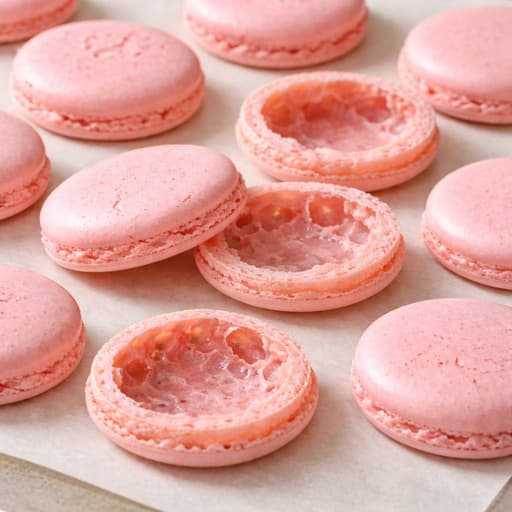
When a macaron turns hollow, the outer shell has usually set faster than the inside could stabilize. The result is a gap between the top shell and the softer interior beneath it. That gap can be small and cosmetic or large enough to affect texture completely, but the underlying issue is usually the same: the structure of the shell and the structure of the center did not finish together.
That is why hollow macarons can fool people. They often look much better than cracked or collapsed shells, but they still signal that the bake was not fully balanced.
A Good-Looking Top Does Not Guarantee a Stable Interior
Macarons are unusually deceptive this way. A smooth top only tells you that the surface baked neatly. It does not tell you whether the inside held on to too much air, dried unevenly, or set too late. In other words, the shell can look polished while the interior is still structurally weak.
This is one reason macarons demand more than visual confidence. The outside often flatters a batch that the inside cannot support.
Excess Air in the Batter Can Leave Space Behind
One common pattern is batter that holds too much air before it goes into the oven. If the meringue is inflated but not stable enough, or if the macaronage leaves the batter too airy, the shell rises and sets while the inside pulls away as it cools. The result is that familiar hollow cap.
That hollow is not always about dramatic overwhipping or obvious bad batter. Sometimes it comes from batter that was only slightly too aerated for the oven conditions it was given.
Heat Can Create Lift Without Enough Interior Support
Macarons also go hollow when the oven drives the shells upward faster than the interior can bake through. In that situation, you get expansion and even decent feet, but the inside does not develop enough support to stay attached to the top shell. Once cooled, the gap becomes obvious.
This is why hollow macarons are often tied to oven behavior just as much as batter behavior. The shell is not simply underbaked or overbaked in a generic sense. It has been pushed into shape faster than it could be set from within.
Drying Helps, but It Does Not Solve Everything
A good skin helps guide expansion, but it does not automatically prevent hollows. Bakers sometimes fix cracking by improving the rest time and then assume the shells are solved, only to find that the interiors are still empty. That usually means the shell surface improved while the batter structure or oven balance did not.
So although cracked macarons and hollow macarons can appear together, they are not exactly the same problem. One is often about visible escape of pressure. The other is more about what happens after the shell appears to have held.
Cooling Reveals Weak Structure More Than Baking Does
Some shells do not look hollow until they have cooled and been opened. That matters. Cooling exposes whether the interior had enough body to stay connected to the shell top or whether it shrank away and left a cavity behind. A shell that seemed fine on the tray can still show you the truth later.
That is why hollows often feel inconsistent. The problem is not always obvious during baking. It becomes obvious when the shell settles and the unsupported space remains.
Better Shells Usually Show a More Even Relationship Between Top, Feet, and Center
When the shell is working properly, the top, feet, and center feel like one structure instead of separate layers. That is what gives good macarons their clean bite and slightly chewy, filled interior. The shell is delicate, but it does not feel detached from the center.
Recipes like French Pistachio Macarons, Lemon Macarons, and Strawberry and Vanilla Macaron are useful reference points because they show the format working the way it is meant to: polished exterior, but also an interior that feels complete rather than empty.
The Pattern Behind Most Hollow Macarons
Most hollows come from imbalance, not from one spectacular mistake. The batter may be a little too airy, the oven may be a little too forceful, or the interior may have set a little too late. Any one of those can be survivable. Together, they leave the shell looking finished before the inside has truly earned it.
That is why hollow macarons are best treated as a structural clue. The batch is telling you that appearance and interior texture parted ways somewhere in the process.
Closing Insight
Macarons do not fail only on the surface. A hollow shell is a reminder that neat appearance and sound structure are not the same thing. The best batches are not just pretty from above; they hold together all the way through.
Related recipes