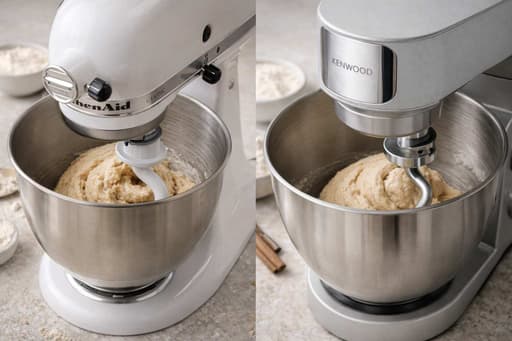
Why I Switched from KitchenAid to Kenwood - A Baker's Perspective on Power, Safety, and Design
A baker's practical comparison of long-mix performance, safety details, and attachment design that led to a KitchenAid-to-Kenwood switch.
Dek: I did not switch because of a logo. I switched because long mixes started feeling risky, messy, and oddly fragile for a tool that should thrive under pressure.
The Moment It Stopped Feeling Like a Workhorse
It happened during a long dough mix, the kind that turns from shaggy to smooth over a patient stretch of time. The KitchenAid body grew warm, then hot, to the point where keeping a hand near the motor felt uncomfortable. In that moment, the question shifted from "Is this iconic?" to "Is this safe?" If a mixer looks great but struggles under the workload I actually give it, that is not a fair trade.
"When the casing feels too hot to touch during a dough mix, it stops being a tool and starts being a risk."
I do not believe one brand is right for everyone. I do believe the daily realities of bread baking reveal strengths and weaknesses faster than any showroom display.
Heat and Motor Strain During Long Mixes
Dough kneading is a stress test. Gluten development asks a mixer to hold torque for extended stretches, and enriched doughs add fat, sugar, and resistance. In my KitchenAid, that strain showed up as noticeable heat after several minutes, especially with stiffer mixes.
With the Kenwood, the same doughs run cooler and more stable. That steadier temperature is not just comfort, it is a sign that the motor and gearing are handling the load without flirting with their limits. The difference matters if you bake bread or enriched doughs weekly. It is also what I hear from other home bakers: Kenwood units tend to cope better with heavy dough and sustained mixing.
Safety and Control: Small Design Choices, Big Consequences
The tilt-head layout on many KitchenAid models places the power switch close to the lift mechanism. It is easy to tap the switch while raising the head, and the mixer can still run when the head is lifted. I learned that the messy way: a quick lift, an accidental start, and dough sprayed across the counter.
Kenwood's lock and interlock design feels more protective. If the head is not fully closed, it will not run. That small restriction has big benefits when you are multitasking or moving quickly between steps. In a real kitchen, that is not a luxury. It is a guardrail.
Attachment Design and Mixing Quality
Whisks seem minor until you are making meringue or sponge batter. I prefer Kenwood's balloon-style whisk because it catches air more evenly and leaves fewer unmixed pockets along the bowl. The motion feels intuitive and consistent.
KitchenAid's wire geometry works, but I often found it less forgiving for delicate tasks. Over time, those small inefficiencies add up. If you whip cream or meringue regularly, the whisk becomes more than an accessory. It becomes a core tool.
What Other Bakers Are Saying
Across forums and reviews, the same themes repeat. Kenwood is praised for dough strength, stability, and a more "industrial" feel. KitchenAid earns admiration for design, color options, and brand history. Many frequent bread bakers mention eventually upgrading or switching once they bake at higher volumes.
None of that makes KitchenAid a poor choice. It simply highlights that use case matters more than reputation.
Value, Power, and Practicality
At similar price points, Kenwood often offers higher power and larger bowl capacity. Wattage alone is not the full story, but it does hint at headroom. What mattered most to me was sustained load handling, not peak numbers. Kenwood feels like a workhorse. KitchenAid feels more like a lifestyle appliance that happens to handle baking well in lighter use.
When KitchenAid Still Makes Sense
KitchenAid has real strengths: the design is iconic, the attachment ecosystem is deep, and for cakes, cookies, and casual baking it performs well. If you bake occasionally or prioritize countertop presence, it is still an easy choice. This is not a universal verdict. It is a baker's reflection on daily workload.
A Quick Task-by-Task Snapshot
| Task | KitchenAid | Kenwood |
|---|---|---|
| Long dough kneads | Warmer under load | Cooler, steadier |
| Safety with head lifted | Can run when lifted | Lock prevents operation |
| Whipping and aeration | Adequate, less forgiving | Airier, more even |
| Design and aesthetics | Iconic, lifestyle-forward | Practical, workhorse-first |
Choosing Based on How You Actually Bake
I switched for three reasons: cooler operation, safer control, and more intuitive attachments. Those are the things that matter when the mixer runs for long sessions and the kitchen is busy. If you are deciding between them, ask yourself how often you bake bread, how long your mixes run, and whether performance or aesthetics is your priority.
If your mixer is a daily tool, build your choice around the daily work.
Closing question: What failed you first - the motor or the design?